
The Monuments We Keep
On now, Jenny Robinson: FRAMEWORKS August 6 -29 and Kathryn Bilharz Gabriel: SUBMERGED opening September 3. NOTE: new gallery hours

Jenny Robinson: FRAMEWORKS
Running August 6th through 29th
New Hours: Wednesday - Saturday | 11 am - 6 pm
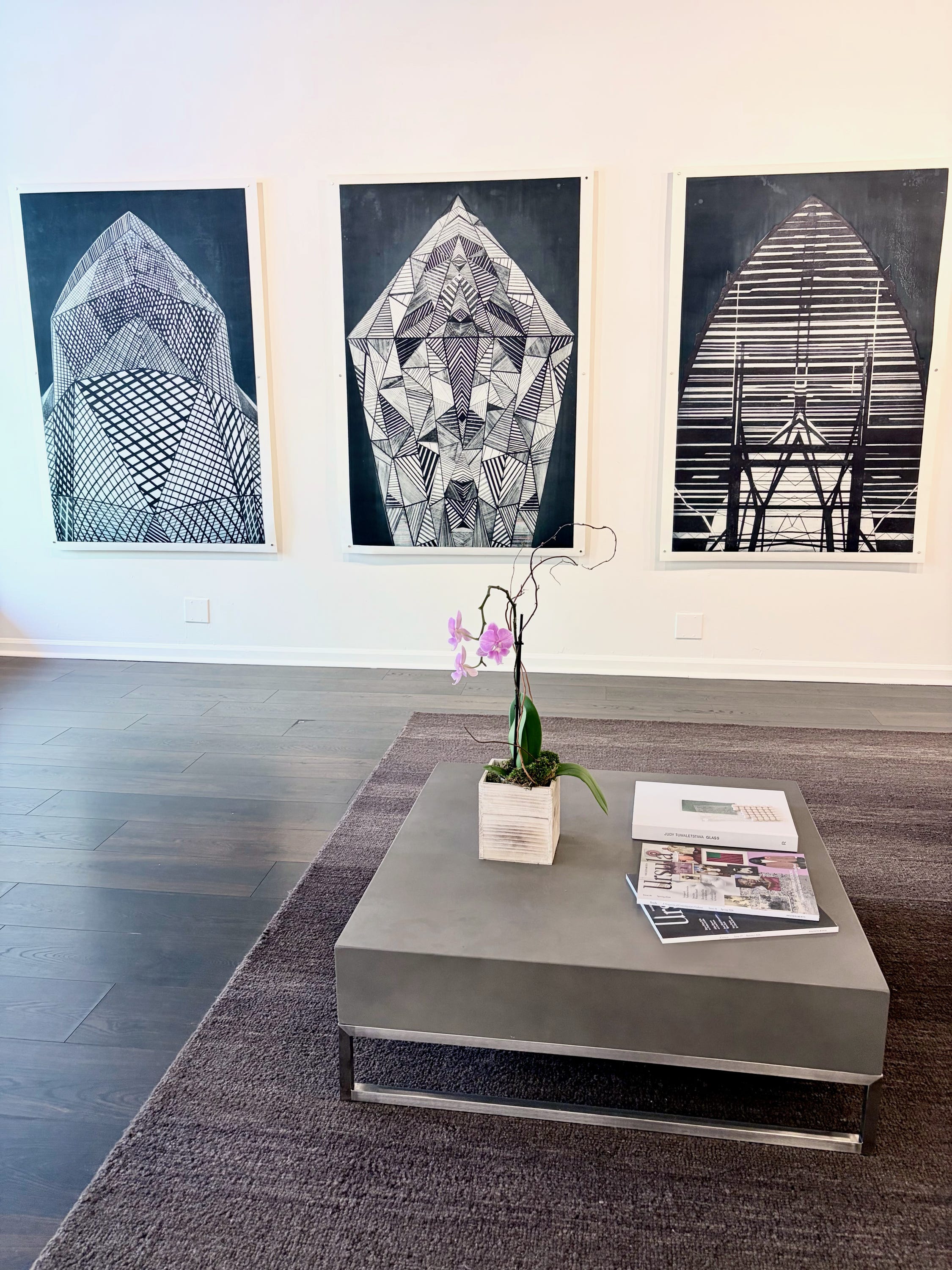
In June, the law firm I work for left an office it occupied for sixty-seven years. The office was in the Norton Building, a quiet Seattle monument. When it opened in 1959, the Norton was the city’s debut to the International Style and, briefly, the tallest building in downtown. It was largely the work of Myron Goldsmith of Skidmore, Owings & Merrill, a former student of Mies van der Rohe. Its opening week included a science and space exhibition with a model of the Century 21 Exposition site planned to open three years later. Despite a warm welcome from the city and its commitment to the future, the Norton is now somewhat forgotten in the modern Seattle skyline.
I wrote both my undergraduate and master's theses on world's fairs like the Century 21 Exposition, and it’s easy to lament that the structures and ideas behind them were only trial runs. Whole cities were built to disappear months later. But the fairs were never an exception to the lifespan of the built world, they are a version running on a truncated timeline. Jenny Robinson’s work not only spotlights the mutable built world, but welcomes the impermanence of the world we create.
Robinson (British, b. 1957) was born in London and raised in Borneo. She earned a BFA in Printmaking from West Surrey College of Art and Design and was an Artist in Residence at Kala Art Institute in Berkeley, California, for over a decade.
Robinson has traveled extensively, living and working in London, San Francisco, Slovenia, and Australia, whose buildings and structures she often references in her work. She has taught at Kala Art Institute, the San José Institute of Contemporary Art, the San Francisco Book Center, and the University of Chico, and in 2019 was awarded the Mario Avati Prix de Gravure by the Académie des Beaux-Arts in Paris.
Frameworks reimagines architecture and structure through abstraction, deconstruction, and repetition. Familiar elements from the built and natural world are distilled into new constructs that blur the line between observation and invention. Robinson builds spaces nestled between history and imagination, using materiality and process to explore how we shape, inhabit, and reconstruct the environments around us.
I have been thinking about which monuments we keep and which we are only passing through. The Norton stood for sixty-seven years of my firm’s working life and will stand long after. The office we left will become someone else’s. Jenny’s prints insist that this is not loss so much as the condition of the built world, and that honoring the impermanence is itself devotion.
Join us as we celebrate monuments. Or see the exhibition online.
- Elizabeth
N. 85
85 Yesler Way
Seattle, WA 98104
Kathryn Bilharz Gabriel: SUBMERGED
Opens Thursday, September 3. West Coast solo debut.
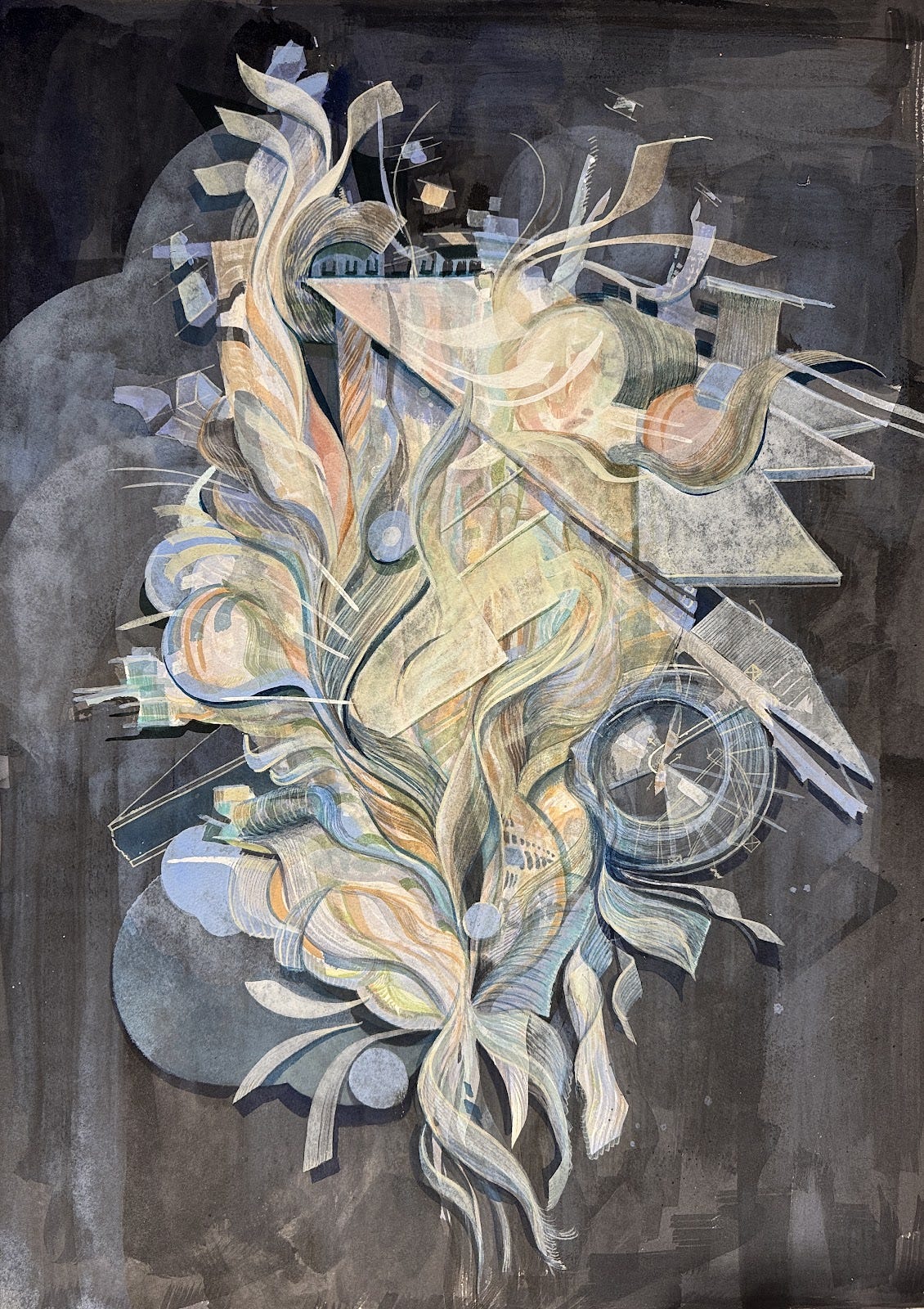
Kathryn Bilharz Gabriel comes from a family of engineers, doctors, and chemists. Her grandfather was among the first nuclear physicists in the United States. At ten she became the youngest recipient of a NASA art award, which sent her to Washington for a week of astronaut lectures and then to Space Camp. The stars stayed in her visual language after that.
She has since made her familial heritage and scientific interests a working inspiration to her artwork. Gabriel has worked with Dr. Eric Coughlin, an astrophysicist at Syracuse University, translating research on black holes and gravitational phenomena into visual form. She brings the same curiosity and knowledge to students in the public high school art department she chairs.
Her visual language is further contextualized by traditional stigmas of women in the sciences. Gabriel notes that machinery and physics are territory coded male, but her practice of layered complexity and organic landscapes upend that structure. The soft painted lines paired with drawn geometric and technological overlays introduce romanticism to the hard science behind it. Her work demands the viewer confront the laws of physics as equally feminine to masculine.
Gabriel’s method is reversed from that of many multi-media painters. The painted passages are laid down first and she draws over them in charcoal, ink and other media. Gabriel calls the result of her layering a “skin” on the paper. The image is fleshed out with contrasting forms both emerging from and subject to the science from which they began. The painting is submerged beneath drawing. The viewer is submerged in complexity. And the artist is submerged in the making.
Lockwood Dennis Closing Remarks
Throughout July, Lockwood Dennis’ loyal collectors made themselves known. We are pleased to meet you all! While the show closed at the beginning of the month, his work remains available. The full show is online, or you can make an appointment to see the prints in person.
Correction: Robinson has taught at the University of Buffalo and Chico State University.
Elizabeth, love your post about the Norton Building and reflections on how Jenny Robinson envisions and renders the radioactive half life of architecture past first intentions. Get your point about buildings persisting but I am still kicking myself for not getting acquainted with the Harbor Club before it closed some 10+ years ago.